ST-UPID · Standard Universal Part Identifier
One standard. One code.
Any maker.
A standard describes an item: ISO 4017 - M12 x 40 - 8.8. Many manufacturers make it, each under a part number of its own, and each of those gets its own Q-UPID. The item the standard describes has had no code of its own.
ST-UPID gives it one.
What a ST-UPID is
A permanent code for the item a standard describes
The ST-UPID, the Standard Universal Part Identifier, is a permanent code for one commodity item whose identity is completely defined by a published standard's designation and by nothing else. It has no manufacturer.
A Q-UPID says "this manufacturer's part number". A ST-UPID says "the item this standard describes". A material master is then described completely by one or the other: a commodity row holds the ST-UPID, a specific row holds the Q-UPID.
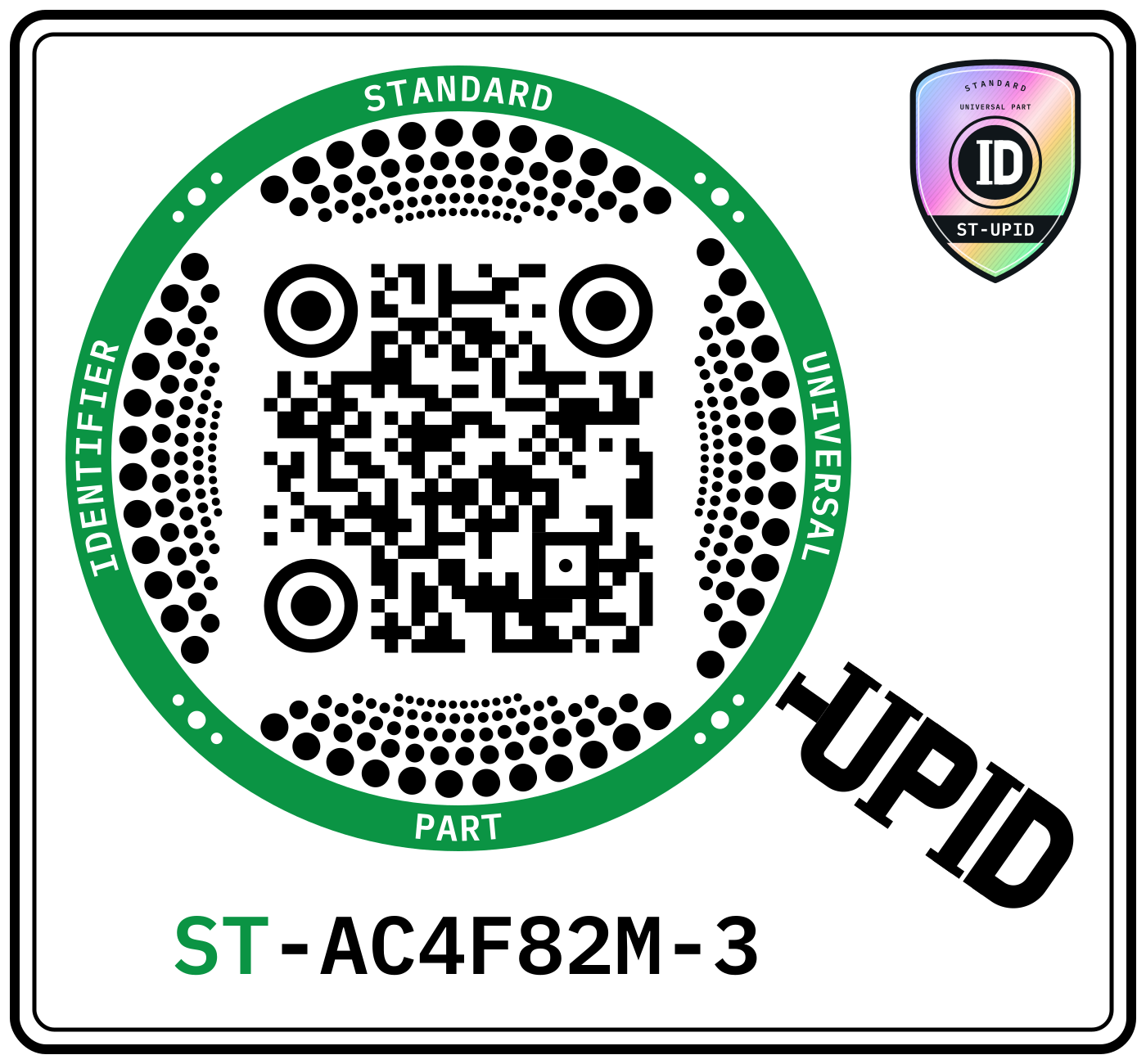
Example: ST-AC4F82M-3 (a reserved demonstration body; no ST-UPID has been issued yet). Same shape as a Q-UPID, same alphabet, same check character; the prefix and the green ring tell the two apart at a glance, on screen and on a label.
Keys look like the designations buyers already write: ISO 4017 - M12 x 40 - 8.8, ISO 15 - 6205. The grammar is the standard's own; the code is the registry's.
Dumb on purpose
It holds a specification and nothing else
A ST-UPID is dumb on purpose. It holds the standard's designation and the attributes the standard's own tables define for it: thread, length, property class and width across flats for a screw; bore, outside diameter and width for a bearing. Nothing more.
It never carries a manufacturer, a maker-specific attribute, an assurance level beyond "standard-listed", a price, a stock figure or an opinion about interchangeability.
If a fact is about a maker's product, it belongs on a Q-UPID. If it is about the standard's item, it belongs on the ST-UPID.
Everything intelligent, who made one, the evidence that a product conforms, availability, attaches to the Q-UPIDs beneath it as dated, sourced claims. The ST-UPID stays as plain as the standard that defines it, which is what lets every system agree on it.
| On the ST-UPID | On the Q-UPIDs beneath it | |
|---|---|---|
| Designation | ISO 15 - 6205 | SKF 6205, 6205-2RSH, 6205-2RSH/C3 |
| Dimensions | 25 × 52 × 15 mm, from the standard's plan | the same, stated by the manufacturer |
| Seal, clearance, cage | not held: ISO 15 does not define them | 2RSH, C3 as the manufacturer's own claims |
| Load rating, speed | not held | catalogue values, source the manufacturer |
| Price, stock | never | a supplier's claims, dated |
| Assurance | standard-listed or existence-evidenced | Source Verified or Manufacturer Confirmed |
Two keys
Q-UPID and ST-UPID side by side
| Q-UPID | ST-UPID | |
|---|---|---|
| Identifies | one manufacturer's part | the item a published standard describes |
| Key | manufacturer + manufacturer part number | standard + canonical designation |
| Example | Q-8U3R3CC-P · SKF 6205 | ST-AC4F82M-3 · ISO 15 - 6205 (demonstration) |
| Evidence | governed sources; the manufacturer's own site | the standard's own tables, cited by table, never copied |
| Assurance | Source Verified · Manufacturer Confirmed | Standard-listed · Existence-evidenced |
| Carries | the identity and the claims about that product | the designation and the standard's parameters |
| Mark | red ring, red Q | green ring, green ST |
| Words in the ring | QUALIFIED UNIQUE PART IDENTIFIER | STANDARD UNIVERSAL PART IDENTIFIER |
| Seal | QUALIFIED, UNIQUE PART, VERIFIED | STANDARD, UNIVERSAL PART, ST-UPID |
| Code | Q-XXXXXXX-X | ST-XXXXXXX-X, same pool, same check |
One registry allocates both. A body used for a ST-UPID is never used for a Q-UPID, and the reverse, so a seven-character body read off a label is unambiguous even without its prefix.
Born from the standard
Built from the standard's own tables, not collected
A designation grammar per standard, plus the standard's size tables, is enough to generate every standard-listed combination. No collecting, no crawling: the codes are born from the tables, each with the standard's attributes as claims whose source is the standard.
ISO 4017 yields 3,318 ST-UPIDs: 237 dimension items across 14 property classes. ISO 15 yields 174 basic designations: 12 series by bore code. Both counts are the enumerator's, from the tables already held in the Material-Masters Builder.
A combination that is grammatical but not listed, an M12 × 41, is held for a steward, or issued when a requester shows a Q-UPID that conforms to it. Somebody made it: that is the evidence, and the page says "existence-evidenced" rather than "standard-listed".
No standard text is stored. A citation names the body, the number and the table, not its contents.
| Standard | Covers | Key | Standard-listed |
|---|---|---|---|
| ISO 4017 | hexagon head screws, full thread | thread × length × property class | 3,318 (237 × 14) |
| ISO 15 | radial bearing boundary dimensions | series + bore code | 174 |
| ISO 4014 | hexagon head bolts | thread × length × class | ranges to verify |
| ISO 4032 | hexagon regular nuts | thread × class | ranges to verify |
| ISO 4762 | hexagon socket head cap screws | thread × length × class | ranges to verify |
| ISO 7089 | plain washers, normal series | nominal size × class | ranges to verify |
Somebody, somewhere, made it
Every ST-UPID lists the Q-UPIDs that conform to it
Behind every ST-UPID sits the list of Q-UPIDs whose manufacturers say their product conforms to it. Each entry is a dated, sourced claim, grouped by manufacturer with a count, under one heading: similar products from other manufacturers.
Three SKF bearings in the registry, 6205, 6205-2RSH and 6205-2RSH/C3, share one ISO 15 envelope, 25 × 52 × 15. One ST-UPID, three Q-UPIDs. The seal and the clearance differ, and the page shows them as each Q-UPID's own claims beside the list.
Conformance never implies interchangeability. That a product conforms to ISO 15 - 6205 says its bore, outside diameter and width match the plan; it says nothing about load rating, speed, seal, clearance, cage or tolerance class. Nothing is ranked and no substitute is recommended.
The Finder reads the list in both directions: "I need ISO 4017 - M12 x 40 - 8.8" shows who makes it; "this SKF 6205-2RSH" shows which commodity need it satisfies.
How a ST-UPID works
Four principles, no exceptions
- PRINCIPLE 1
Standard-Defined
The standard's designation is the whole identity. Edition is not part of the key: a revised table keeps the code.
- PRINCIPLE 2
Maker-Free
No manufacturer, ever. Makers live on the Q-UPIDs beneath it, as conformance claims.
- PRINCIPLE 3
Listed, Never Guessed
Issued for a standard-listed combination, or for one somebody has shown exists. Nothing is inferred.
- PRINCIPLE 4
Permanent and Immutable
A code is never changed, reused or reassigned, and its body is never reused as a Q-UPID.
Scope
What it is not
A ST-UPID is not a register of equivalents. Two manufacturers' products that conform to the same ST-UPID are similar, never identical; equivalence, supersession and compatibility belong in a separate layer, never inside the identifier.
It is not a copy of the standard. It holds designations and parameter values with a table citation; it quotes no text and redistributes no table.
It is not a replacement for the Q-UPID. A commodity need is stated with a ST-UPID; a specific purchase, a stock record or a warranty still names the maker's code.
Status
Where it stands
- FixedThe code family ST-XXXXXXX-X: one body pool shared with Q-UPIDs, the same alphabet and check (7 Nov 2026).
- FixedThe name and its expansion, Standard Universal Part Identifier; the green ring and ST prefix; the STANDARD seal (8 Nov 2026).
- In reviewThe allocation rules, the two assurance wordings and the first wave of standards.
- NextThe registry change: the pool, the key table and a kind-aware lookup at q-upid.com/ST-…; then the first wave enumerated from the tables.
- ThenThe Finder in both directions, the Excel add-in, and standards beyond the first wave once their licences are checked.
Take part
Name the item once; let every maker attach to it
If you publish a standard, make parts to one, or build the systems that hold them, the conformance list is where your products become findable by the need they meet, under your own part number and your own Q-UPID.
To find out how to take part, send an enquiry or email [email protected].